


Sailing from Florida to the Bahamas is one of the most exciting yacht charter routes in the Caribbean, offering a short yet authentic offshore crossing through the Gulf Stream. Departing from Miami’s modern marinas, you can reach the turquoise waters and white-sand beaches of Bimini within just a few hours. The area is perfect for sailors who want to explore tropical islands, shallow anchorages, and scenic cruising grounds within a one-week charter. This guide helps you understand the local conditions and plan a practical 7-day sailing itinerary.
- Important information if you would like to sailing from Florida to the Bahamas
- Which month is best for sailing in the Bahamas?
- Sailing from Florida to the Bahamas: 7 days Bimini catamaran tour
- Marinas around Bimini
Important information if you would like to sailing from Florida to the Bahamas
Avoid Holiday season
the Bahamas is beloved during the holiday season except for fall, the winter period is by far the most common time to go. For example, George Town shares a popular anchorage with hundreds of boats, while in the summer period you might find a place for yourself easier.
Weather conditions – cold fronts
you do not want to be caught in the Gulf Stream, we suggest to plan your crossing in a good weather window with light breezes (with nothing out of the north for several days prior to your journey)
Route suggestion
the best and fastest way to reach the closest Islands of Bahamas is leaving from Florida to Bimini, what more Miami (South Florida) is only 50 nauticalmiles away in less than 3 hrs. Rent a boat in Florida and experience what it feels like when everything is perfectly timed – the sunset, the sea, and freedom.
Pick a suitable yacht
besides the good weather conditions, consider taking this crossing route (Florida – Bimini) with an experienced sailor or we recommend directly flying there to the Bahamas. Choose a power yacht or powerboat which crosses to Bimini in 2.5-4 hours, otherwise, we suggest flying to Bimini (or to other ports in the Bahamas) to start your journey there.
Sailing conditions
if you choose a sailing boat, we are talking about an overnight trip, which’s sailing time can go up to min 8 hrs under good weather conditions, but it can take more (!) Radar recommended
Extra expenses
not only alcoholic beverage and food are expensive but you need to check in to clear Bahamas customs and pay the rather steep 300 USD per boat cruising tax.
Please find our sailing itinerary from Miami to Bimini below:
Which month is best for sailing in the Bahamas?
The best sailing season in the Bahamas generally runs from December to May. During these months the region benefits from steady trade winds, comfortable temperatures and predictable sea conditions, making island-hopping especially enjoyable.
Spring is one of the most pleasant periods for sailing in the Bahamas. From March to May daytime temperatures usually range between 24–28 °C (75–82 °F), while the sea gradually warms to around 24–26 °C. Northeasterly trade winds typically blow between 10 and 18 knots, offering excellent sailing conditions for passages between the islands. The sea is often calm or moderately rippled, and visibility is excellent, which is helpful when navigating the shallow banks and sandbars that characterize Bahamian waters. Charter activity is lively, but the islands still feel relaxed rather than crowded.
Summer brings warmer and more humid conditions. Between June and August air temperatures frequently reach 30–32 °C (86–90 °F), and sea temperatures climb to around 28–30 °C. Winds are often lighter, commonly around 8–12 knots, which means slower and more relaxed sailing days. The sea is usually calm, though afternoon showers and thunderstorms can develop due to the tropical climate. This period also marks the beginning of hurricane season, so careful weather monitoring is essential when planning longer passages. Tourist numbers tend to be lower, offering quieter anchorages and marinas.
Autumn is a transitional season in the Bahamas. From September to November temperatures remain warm, typically between 26–30 °C, and the sea is still pleasantly warm around 28 °C. Winds can be more variable, often ranging from 10–20 knots as weather systems shift across the region. September is usually the peak of hurricane season, so sailors pay close attention to forecasts. By November, more consistent northeasterly winds begin to return, and sea conditions gradually stabilize. Charter activity also begins to increase as the winter sailing season approaches.
Winter is the classic sailing season in the Bahamas. From December through February daytime temperatures usually sit between 22–26 °C (72–79 °F), with sea temperatures around 23–25 °C. Northeasterly trade winds often blow at 12–20 knots, providing lively yet comfortable sailing among the shallow turquoise banks and island chains. Occasionally cold fronts sweep down from North America, bringing short periods of stronger winds and rougher seas, but these typically pass quickly. During winter the charter fleets and cruising community are very active, and marinas and anchorages have a vibrant, welcoming atmosphere.
Sailing from Florida to the Bahamas: 7 days Bimini catamaran tour
A short but true offshore passage between Miami and Bimini where the Gulf Stream current and shifting weather conditions make proper timing essential. It’s an excellent route if you want to experience a quick Bahamian island-hopping adventure. Recommended level: intermediate Open sea passages: yes
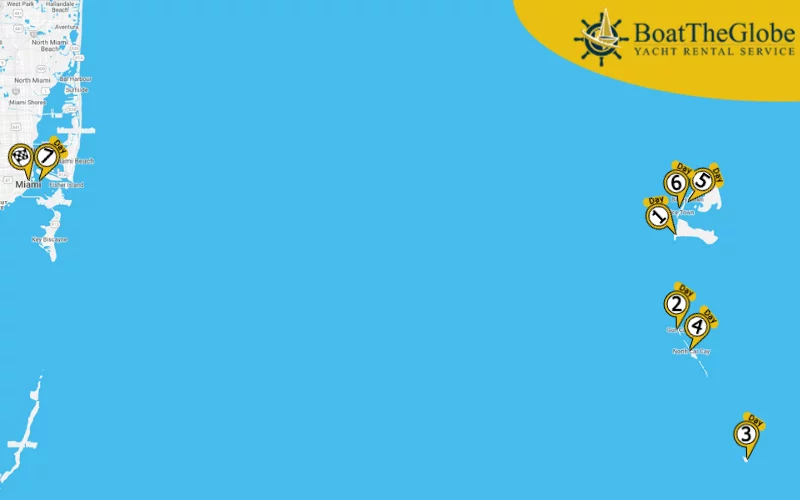
Day 1: Miami – Port Royal (44.6 nm – Sailing time*: about 7 hours), Day 2: Port Royal – Gun Cay (Honeymoon Harbour) (7.5 nm – Sailing time*: about 2 hours), Day 3: Gun Cay – Ocean Cay (11.6 nm – Sailing time*: about 2 hours), Day 4: Ocean Cay – North Cat Cay (Honeymoon Harbour) (11.6 nm – Sailing time*: about 2 hours), Day 5: North Cat Cay – Bailey Town (9.6 nm – Sailing time*: about 2 hours), Day 6: Bailey Town – Alice Town (1.3 nm – Sailing time*: about 1 hour), Day 7: Alice Town – Miami (44.8 nm – Sailing time*: about 7 hours)
* – an average 43 ft sailing yacht, with average weather conditions, sails around 6-7 knots per hour.
Read more about sailing to the Bahamas, or Bahamas sailing tours
How to choose a sailing route from Florida to the Bahamas?
- If this is your first Gulf Stream crossing: choose the shorter Miami–Bimini route with a stable weather window.
- If you prefer relaxed island hopping: stay around Bimini and nearby cayes with shorter daily distances.
- If speed and comfort matter most: a motor yacht or fast catamaran can significantly reduce crossing time.
- If you want to maximize experiences in one week: plan a circular itinerary with several stops around Bimini and nearby islands.
Marinas around Bimini
- Browns Marina – Alice Town GPS Coordinates: 25.723060, -79.299206
- Bimini Blue Water Marina – Alice Town GPS Coordinates: 25°43’30.8″N 79°17’53.4″W
- Fisherman’s Village Marina – North Bimini GPS Coordinates: 25.747530, -79.280335
- Mega Marina – North Bimini GPS Coordinates: 25°45’08.9″N 79°16’39.7″W
- Bimini Sands Resort & Marina – South Bimini GPS Coordinates: 25.711306, -79.300708
- Resorts World Bimini Resort and Marina – North Bimini GPS Coordinates: 25°44’55.2″N 79°16’56.0″W
- Bimini Big Game Club Resort & Marina – Alice Town GPS Coordinates: 25°43’37.1″N 79°17’43.8″W
- Honeymoon Harbour – Gun Cay GPS Coordinates: 25°35’16.0″N 79°18’14.7″W
- Ocean Cay Village & Marina – Ocean Cay GPS Coordinates: 25.418772, -79.203915
Read more Caribbean sailing routes
Plan your own Bahamas sailing adventure starting from Florida and find the perfect charter yacht for your trip. Request an offer and start preparing for an unforgettable Caribbean sailing experience.
