


Bosa is an excellent charter base on Sardinia’s west coast if you are looking for quieter harbours, scenic shorelines, and varied one-week sailing plans. From here, you can easily combine cultural stops, historic port towns, and wild coastal stretches, shaping the trip to match your crew’s pace. The area is especially appealing for sailors who want more than beaches, with gastronomy, nature, and local character all built into the route. The itineraries below help you decide which Bosa sailing plan best fits your style of cruising.
This article gives you an overview of the following topics:
- Which month is best for sailing in Bosa?
- Ports around Bosa
- Sail in Bosa! Bosa sailing itineraries:
- Sailing around Bosa: Plan for a one-week-long sailing trip (South)
- Bosa sailing: 7 days sailing itinerary Long (North)
- Marine gas near Bosa
Which month is best for sailing in Bosa?
The best time for sailing in Bosa is usually from May to late September, with June and September often offering the most balanced conditions. During this period, Sardinia’s west coast is pleasantly warm, the sea steadily takes on its summer warmth, and the wind is often lively without the peak-season crowding of high summer.
Spring: In spring, the Bosa area feels fresh, open and wonderfully clear, with longer daylight and an increasingly inviting coast. March can still feel cool and breezy, but from April onward conditions become far more comfortable, with daytime temperatures generally around 16–22 °C, occasionally reaching about 24 °C by late May. The sea is still cool in spring, usually around 15–18 °C, so swim stops feel refreshing rather than fully summery. Because Bosa sits on Sardinia’s exposed west coast, the effect of the Mistral is already noticeable in this season, and many sailing days bring winds around 10–18 knots, with stronger gusts during unsettled weather. The sea state can therefore be more active offshore, with shorter, livelier waves, but marinas and anchorages remain quieter and the overall traffic level is still moderate, which makes spring especially attractive for crews looking for a more spacious and authentic side of Sardinia.
Summer: Summer turns Bosa into a Mediterranean postcard, with warm air, bright skies and intensely coloured water. From June to early September, daytime temperatures are typically around 27–31 °C, while the sea warms to about 21–25 °C, reaching its most comfortable levels in August. Winds are often friendlier and more relaxed, commonly around 8–15 knots, although the west coast can still see stronger Mistral episodes that push conditions above 20 knots and call for more careful route planning. Mornings and more sheltered stretches are often smoother, while the open sea can become choppier later in the day. July and especially August are the busiest months, so the marina, beaches and popular stops all feel more animated, even though Bosa usually remains more relaxed than Sardinia’s best-known northern charter hubs.
Autumn: Autumn is often a favourite season among experienced sailors around Bosa, because the sea keeps much of its summer warmth while the coastline gradually becomes calmer again. In September and the first half of October, daytime temperatures are usually around 22–28 °C, before easing back toward 17–20 °C in November. The sea is still notably warm in September at roughly 24 °C, remains pleasant in October, and cools toward about 19 °C by November. Winds become more changeable, often falling in the 12–20 knot range, and autumn systems can build sea state more quickly along this open west-facing coast, so forecast awareness becomes especially important. In return, September and October often deliver a very appealing balance: warm water, beautiful light, and noticeably less crowding than in August.
Winter: Winter in Bosa is more a season for experienced crews who are comfortable with a livelier weather pattern. Daytime temperatures are usually around 13–16 °C, nights are cool, and sea temperatures hover near 14–15 °C. This is the windiest part of the year, and on Sardinia’s west coast the Mistral and passing fronts regularly bring winds in the 15–25 knot range, with stronger periods possible. The sea is more often rough or unsettled, especially on open west-facing stretches, so winter sailing requires a more conservative approach. On the other hand, the harbour and town feel much quieter, and Bosa takes on a raw, cinematic beauty that suits sailors who enjoy characterful sea days more than classic swim-and-sun charter conditions.
Ports around Bosa
The port of Bosa
There are 120 moorings, and the maximum allowed length of boats is 30 metres. They provide water, electricity and fuel in the protected place. You can eat nearby, and there is also a supermarket. Rent a boat in Bosa and enjoy complete tranquility as you glide from one beautiful bay to another.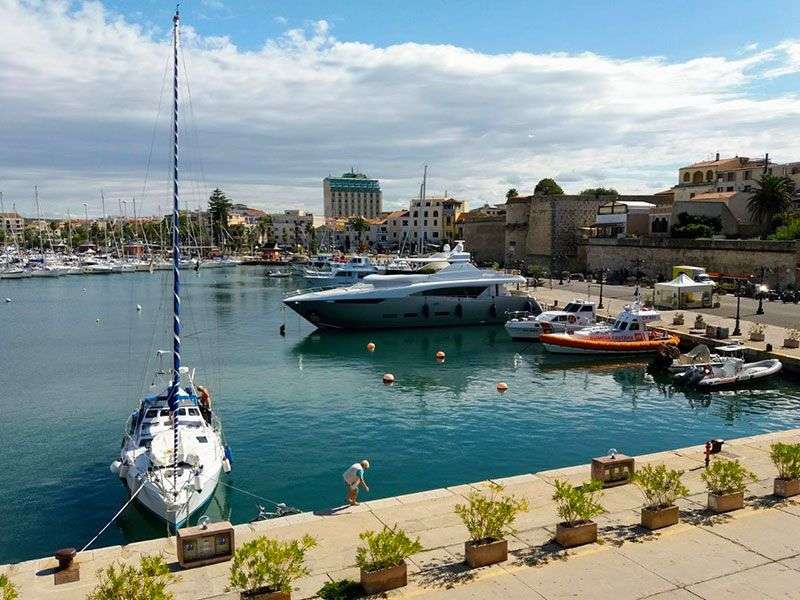
The port of Alghero
The port is 150 metres long. There are 400 permanent moorings for boats with a maximum length of 50 metres. Ferries leave towards Civitavecchia, Palermo and Naples.
The port of Porto Torres
They have 400 moorings for yachts as long as 40 metres. We can dock in the ferry port with larger boats. There are bars, restaurants and different shops nearby. There are ferries leaving for Genoa, Marseille, Toulon, Barcelona and Civitavecchia.
Port of Portoscuso
The port has 385 berths for boats up to the length of 25 metres. The depth can be 3-4, 5 metres at the docks. Water, electricity and waste collection are among the services of the port.
Port of Carloforte
The marina of Marine Sifredi has 250 berths for sailing yachts and boats up to the length of 60 meters. You have access to services such as Wi-Fi, electricity, laundry, pharmacy or medical care. Carloforte sailing
Sail in Bosa! Bosa sailing itineraries
HELP ME TO CHOOSESailing around Bosa: Plan for a one-week-long sailing trip (South)
This one-week route from Bosa combines coastal stops, cultural highlights, and gradually longer legs as it heads south, making it a strong choice for crews who want variety without losing structure. Because the later stages are longer and more exposed, early departures and close weather checks are especially important. Recommended level: intermediate Open sea passages: yes
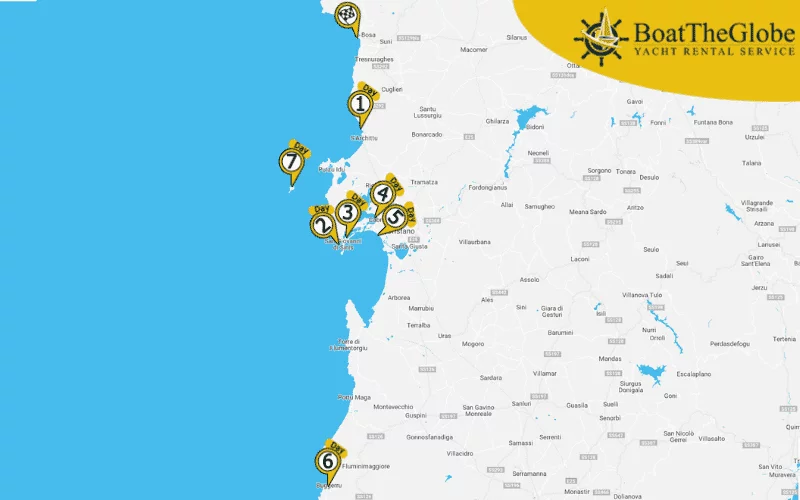
Day 1: Bosa – Santa Caterina di Pittinuri (11.7 nm – Sailing time*: about 2 hours)
First, sail to the coastal town of Santa Caterina di Pittinuri; it has a sandy beach where you can marvel at the unique rocky landscape around you. The spectacular cliff S’Archittu can be found here; swimming and canoeing will become an unforgettable experience if you are bound to travel here. Do not forget to visit the Santa Caterina Church either.
Day 2: Santa Caterina di Pittinuri – San Giovanni di Sinis (16.9 nm – Sailing time*: about 3 hours)
After leaving Santa Caterina di Pittinuri you arrive at a former fishing village called San Giovanni di Sinis. The most significant sight of this coastal resort is the Spanish tower of San Giovanni. Philip II had it erected between 1580 and 1610 to prevent pirate attacks. If you happen to have a bit more time, the central square awaits you with a 5-century old Paleo-Christian temple.
Day 3: San Giovanni di Sinis – Tharros (2.6 nm – Sailing time*: about 1 hour)
If you dock here, you can explore one of the most valuable archaeological treasures of Sardinia in the ancient ruins. The archaeological site is not only special because it is facing the sea, but it is also an open-air museum where you can see churches, baths and a necropolis. It feels like travelling back in time.
Day 4: Tharros – Cabras (5.4 nm – Sailing time*: about 1 hour)
You can find precious architectural findings in the Architectural Museum here. Do you want to satisfy your taste buds? Then visit Il Caminetto, one of the most popular seafood restaurant which lies in the historical centre. You can get to know such classical meals of Sardinia such as smoked mullet or spaghetti shell. Furthermore, you should also order either a plate with seafood or pizza slices at L’Oliveto.
Day 5: Cabras – Oristano (Marina di Torre Grande) (3.3 nm – Sailing time*: about 1 hour)
The city has beautiful Renaissance and Baroque buildings. Do you have more time to spend here? You should also see the cathedral, the Tower of St. Christopher and the local museum. Oristano is famous for its equestrian carnival which has a 500-year-old tradition. They organise it during the carnival season, on the last but one Sunday and the Tuesday following it.
Day 6: Oristano (Marina di Torre Grande) – Buggerru (31.5 nm – Sailing time*: about 5 hours)
The next stop is Buggerru, a former mining town. The two famous sites of the town are San Giovanni Battista Church and the wonderful bay of Cala Domestica, 1.1 nm from the town south. For climbers, the over 100-metre high cliffs are excellent challenges.
Day 7: Buggerru – Island of Mal di Ventre – Bosa (55.0 nm – Sailing time*: about 9 hours)
The first name of Mal di Ventre Island was Maluentu. It is unpopulated lying a few kilometres from the Sardinian shore. The southern coastline is rocky whereas the eastern hides breath-taking coves like Cala Valdaro. There is a lighting tower on the island’s highest point, 18 metres above seas level. After Maluentu, we return to our first stop, Bosa. You should definitely try the frutti di mare in one of the cosy restaurants; as for wines, we recommend Malvasia.
* – an average 43 ft sailing yacht, with average weather conditions, sails around 6-7 knots per hour.
Bosa sailing: 7 days sailing itinerary Long (North)
This itinerary links Bosa with some of the standout ports of northwestern Sardinia, starting with shorter sailing days and ending with a particularly long final leg. It is best suited to crews willing to handle a more demanding finish while enjoying a broad mix of coastline and harbour atmospheres in a single week. Recommended level: advanced Open sea passages: yes
Day 1: Bosa – Alghero (19.2 nm – Sailing time*: about 3 hours), Day 2: Alghero – Porto Conte (7.8 nm – Sailing time*: about 1.5 hours), Day 3: Porto Conte – Cala dell’Argentiera (16.7 nm – Sailing time*: about 3 hours), Day 4: Cala dell’Argentiera – Stintino (20 nm – Sailing time*: about 3.5 hours), Day 5: Stintino – Porto Torres (11.1 nm – Sailing time*: about 2 hours), Day 6: Porto Torres – Castelsardo (15.8 nm – Sailing time*: about 2.5 hours), Day 7: Castelsardo – La Pelosa – Bosa (72.3 nm – Sailing time*: about 11.5 hours)
* – an average 43 ft sailing yacht, with average weather conditions, sails around 6-7 knots per hour.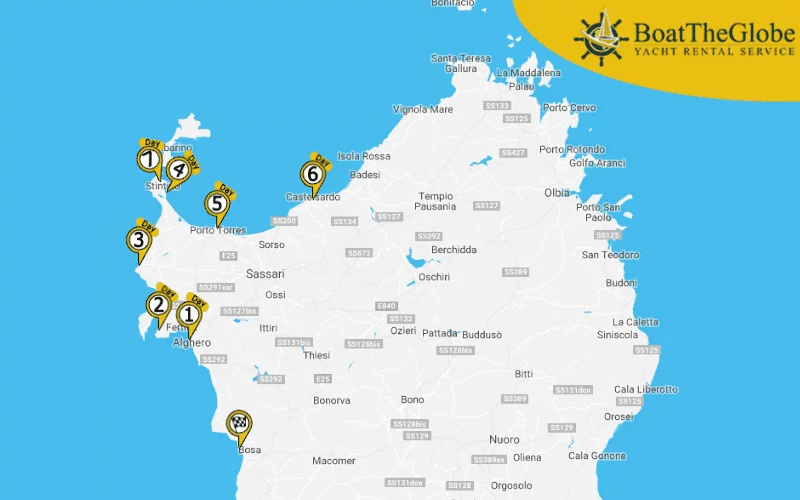
How to choose a Bosa sailing route?
- If you want cultural stops and varied coastal days: choose the 1-week sailing itinerary, which connects several smaller destinations at a steady pace.
- If you want northwestern Sardinian ports and a bigger touring feel: the 7-day Bosa sailing route is the better fit, linking more well-known harbours in one circuit.
- If your crew is less experienced: follow a plan where the longer legs can be shortened or balanced with a more flexible schedule.
- If secure weather timing matters most: plan extra flexibility around the route with longer open-water stretches.
Marine gas near Bosa
- BOSA: Depth:3, 5m, Working time: 0-24 depending on the season (to be agreed upon before arrival) depending on the season (to be agreed upon before arrival), GPS Coordinates: 40.2972019, 8.4848895
- ALGHERO -Port Conte Marina: Depth:2, 5 m, Working time: 8-18, GPS Coordinates: 40.5926808, 8.2513785
- CARLOFORTE: Depth:4, 5m, Working time: 9-22, GPS Coordinates: 39.1347, 8.2981
- CAGLIARI: Depth:7 m, Working time: 8-24, GPS Coordinates: 39.207, 9.122234
If you would like to go sailing, Bosa and its neighbourhood is an excellent choice. The island of Sardinia welcomes you with a pleasant Mediterranean climate and ideal wind conditions. Regardless of where you dock, you can see beaches of picturesque beauty, as well as cultural and natural sights.Find more Sardinian sailing trips, boat rental Sardinia.
Request a quote for a Bosa-area charter and we’ll help match the route to your crew’s level and preferred pace. Set off well prepared and make the most of Sardinia’s western coastline.
