


Are you planning to sail from Greece to Turkey? Sailing from Greece to Turkey is one of the best “two countries – one week” experiences in the Aegean: short crossings, well-organized ports, iconic islands and the comfortable marinas of the Turkish Riviera all in one itinerary. The key to success is choosing the right season (Meltemi!), knowing the entry formalities in advance and adjusting the daily distances to your own experience. In this guide, you will find the most popular crossings (Kos-Bodrum, Rhodes-Marmaris, Leros-Knidos), a 7-day two-country cruise, and when which route is the safest and most enjoyable choice.
Here’s what the article will cover:
- How far is it, and how long does it take to sail from Greece to Turkey on a private yacht?
- Which month is best for sailing from Greece to Turkey?
- Important things to know when sailing from Greece to Turkey
- Ports along the shared coasts of Greece and Turkey
- Sailing from Greece to Turkey: sailing itineraries
How far is it, and how long does it take to sail from Greece to Turkey on a private yacht?
The distance between Greece and Turkey by sailing depends on which route you choose. The coasts of the two countries in the Aegean Sea are only 10 – 15 nautical miles apart in several places – for example, between Kos and Bodrum, the distance is about 12 nm. A shorter crossing on such a section takes 2.5-3 hours in good weather. If you are sailing on a longer route, such as from Athens or the Cyclades, the distance can be 100-200 nautical miles, which requires several days of sailing, depending on wind conditions and stops. The safest period for beginners is typically May-early June and September-early October, while the Meltemi peak (July-August) can be stressful in several regions. A well-maintained sailboat, around 40 feet long, will travel at an average speed of 5-7 knots, which allows you to plan your route and travel time realistically.
Important things to know when sailing from Greece to Turkey
If you’re sailing from Greece to Turkey, it’s worth considering a few practical points in advance. First, the two countries use different currencies: Greece uses the euro, while Turkey uses the lira. This can matter even for smaller expenses-fuel, restaurants, marina fees-since exchange rates may fluctuate. Marina fees in Turkey are generally lower than in the popular Greek island ports, but prices vary depending on the season and the size of your boat.
Entry into Turkey is only possible at designated clearance ports; passport control, crew list and presentation of ship’s papers are typical. Also check Greek exit procedures before departure (may vary locally) and have valid insurance on hand. Some marinas may charge a customs or entry fee, usually just a few euros or lira. Fuel prices and service costs also differ between the two countries; for example, marinas along Turkey’s southern coast often offer better rates, though the level of service can vary.
When sailing, pay close attention to local wind conditions and weather forecasts: the Meltemi-an intense northerly summer wind-can significantly affect travel time, so it’s wise to keep your schedule flexible even on shorter passages. Finally, local regulations and fee schedules are updated regularly, so checking the marina’s website or official sources beforehand is highly recommended. These small preparations make the crossing much smoother and help you avoid unpleasant surprises.
Which month is best for sailing from Greece to Turkey?
The best time for sailing is late Spring (May, early June) and early Autumn (September, early October). At this time, the sea shows its kindest face: warm but not raging, predictable but not boring.
During Spring, the Aegean Sea is a bit sleepy, sometimes even grumpy, but fundamentally friendly. The wind is mostly gentle and predictable, the marinas are quiet, and the coastal tavernas haven’t yet been overtaken by tourist music. If you love nature when it’s not loud but stretching out gently, this is your season.
Then comes Summer, and with it the Meltemi – the infamous north wind that the Greeks say “gives life to the sea”. This wind in July and August often blows at 20-30 knots, which can be quite challenging for novice sailors. For experienced sailors, this challenge is bliss: tight sails, a pitching boat. If you’re a beginner, this period won’t be about relaxation.
Autumn is pure harmony. The sea is still warm, the wind friendlier again, and the sunsets color the water as if someone sprinkled gold dust on it. Fewer boats are out, marinas have space again, and locals regain their patience after the long summer. This is the true soul of sailing – when you are no longer dictated by the weather, but you decide where to go.
Winter is a completely different story. The Aegean Sea is capricious, cool, and lonely. The waves are darker, the wind often lashes the coasts, and most sailors prefer planning the next season by the fireplace.
Ports along the shared coasts of Greece and Turkey
Kos – Bodrum
Kos is an excellent starting point if you want a quick crossing to Turkey, as Bodrum is only about 12 NM away. From a sailor’s perspective, this is an ideal, short passage, but always check the latest wind data and wave forecast before departure. Bodrum Marina is well-equipped: shaded berths, water/electricity, technical support, fuel points, and several charter-friendly services. If you arrive with a charter boat, it is advisable to reserve your berth in advance since the summer months bring heavy traffic. Shopping and provisioning in Bodrum can be done quickly and at good prices before continuing along the Turkish coastline. yacht charter Kos Recommended level: Beginner, intermediate-advanced. Open sea sections: no (shorter but more open crossing).
Rhodes – Marmaris
The crossing from Rhodes to Marmaris is about 35 NM, making it a comfortable, one-day passage. Wind conditions in the area change frequently, so from a sailor’s perspective, it’s essential to time departures and arrivals according to the wind, especially for charter crews. Marmaris’ modern marinas (e.g., Netsel Marina, Albatros Marina) offer high-level services such as boat maintenance, fuel, grocery shopping, boat washing, and fast administration. If you plan to stay overnight, booking in advance is highly recommended. Marmaris is also an ideal starting point for exploring other Turkish bays-you can easily continue to Göcek or Fethiye. boat hire Rhodes town Recommended level: Intermediate-advanced. Open sea sections: yes (if a channel/opener water and wave can be built).
Kalymnos – Datça
The 25-30 NM distance between Kalymnos and Datça is a short but enjoyable leg – it is mandatory to complete Turkish entry formalities. Navigationally favourable, currents are weak in this region, making it a comfortable route even for less experienced charter crews. Datça harbor is smaller but well protected against northwest-northern winds, though berths fill up quickly, so early arrival or radio coordination is recommended. Water/electricity is available, but for larger provisioning, it’s better to prepare in Kalymnos or larger Turkish towns. Nearby coastal bays-Palamutbükü and Hayıtbükü-are ideal for anchoring, with good sandy bottoms. Recommended level: Beginner, intermediate-advanced. Open sea sections: no (if near the coast/strongly protected).
Leros – Knidos
The 35 NM crossing from Leros to Knidos is a classic, historic sailing route, where the strength of the Meltemi wind greatly affects comfort. Knidos harbour is iconic but has limited berths, so it is strongly recommended to reserve your spot by phone or radio in advance. Anchoring is also an option, but the seabed is sometimes rocky, making proper anchor setting important. The coastal stretch is protected, providing a good overnight spot. If time permits, a short shore walk is worthwhile, as the harbor is right next to ancient ruins. Not all ports are authorized to allow entry, so you should always check this before departure. Recommended level: Intermediate-advanced, advanced. Open sea sections: yes (if a channel/opener water and wave can be built).
Patmos – Datça / Bodrum
The crossing from Patmos ranges between 40-50 NM, making this a more serious, full-day leg, requiring precise route planning. Depending on your destination (Datça: shorter; Bodrum: longer), it’s important to consider wind direction and incoming waves, as these greatly affect passage time. Both Datça and Bodrum offer good services, but charter fees may vary, so checking marina websites in advance is recommended. For larger provisioning, Bodrum is the best choice, while Datça is a quieter, lower-traffic alternative. Recommended level: Advanced. Open sea sections: yes (if a channel/opener water and wave can be built).
rent a boat in Greece
Sailing from Greece to Turkey: sailing itineraries
7-day Greek – Turkish round trip
A varied, well-structured two-week taster condensed into one week: Greek island atmosphere + Turkish marina experience, with several short and some medium-length cruises. Pay attention to entry/exit formalities and plan a spare day in case the Meltemi forces you to do so. Recommended level: Intermediate-advanced Open sea sections: yes (shorter but more open crossing).
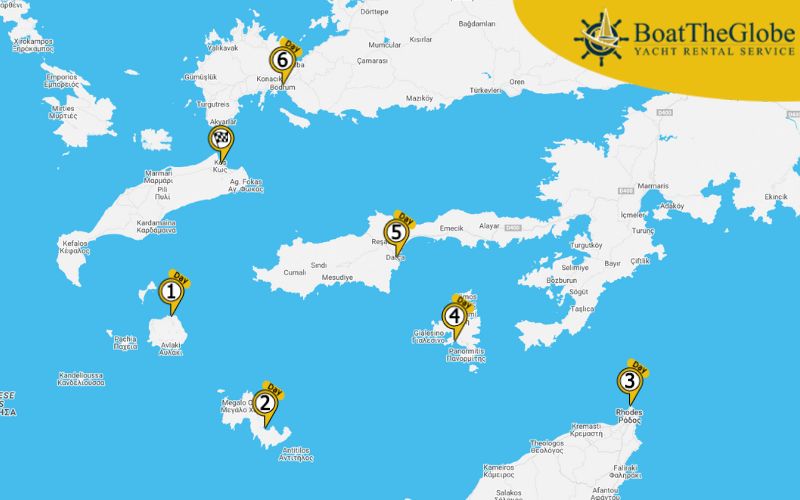
Day 1: Kos → Nisyros
17.8 nm, sailing time: 3 hours. Departing from Kos harbour, you can quickly reach Nisyros, an island famous for its volcanic landscape. Near Mandraki Harbor, there’s an opportunity for a short hike to the volcanic crater, which offers a spectacular view, and you can also try some local thermal baths. After sailing, it’s worth exploring the island’s tranquillity and the charm of its small village.
Day 2: Nisyros → Tilos
15.1 nm, sailing time: 2.5 hours. Upon arriving at Tilos, you’ll spot traditional whitewashed houses and a small harbor nestled in calm bays. The island holds significant natural value, including rare bird species, and a short walk allows you to discover its greener side. Be sure to sample fresh fish at local tavernas.
Day 3: Tilos → Rhodes
24.8 nm, sailing time: 4 hours Heading towards Rhodes, the blue of the sea deepens gradually, and upon arrival, historic city walls and medieval streets greet you. The city is famous for its buildings from the Knights’ era, while modern cafes and restaurants are also present. A stroll along the peaceful harbor promenade is recommended before further exploration.
Day 4: Rhodes → Symi
20.0 nm, sailing time: 3 hours. Symi’s small harbor stands out with its distinctive neoclassical houses, which shine in picturesque colors under the sun. The island is famous for sponge diving, so you may often see local fishermen at work, and the tavernas offer fresh sponge fish specialities. A short walk in the town nicely complements the sailing experience.
Day 5: Symi → Datça
11.9 nm, sailing time: 2 hours. Upon arrival at the Datça Peninsula, which belongs to Turkey, it is mandatory to complete Turkish entry formalities. The peninsula is famous for its olive and almond trees, as well as local handicrafts. If time allows, you can explore nearby small bays with short sailing trips.
Day 6: Datça → Bodrum
24.8 nm, sailing time: 4 hours. Bodrum Harbour combines a modern marina with a historic town. The city is known for the famous Bodrum Castle, which houses the local archaeological museum. Around the harbor, numerous restaurants and cafes await, making it a perfect spot to relax and enjoy the city atmosphere upon arrival.
Day 7: Bodrum → Kos
10.3 nm, sailing time: 1.5 hours. The short return trip to Kos is quick, leaving time for a harbour stroll or one last beach relaxation. In Kos town, it’s worth visiting the ruins and enjoying the ambiance of the old harbor, where local markets and cafes provide refreshments for your final day. This short leg offers a relaxed closure before you dock the boat. Returning to Kos involves another Greek entry procedure.
Sailing route plan from Greece to Turkey
This is a “distance and rhythm” route: several longer cruises, more open sections and greater weather dependence, in return for less crowds and a stronger boat experience. It’s good if you’re comfortable with long days and have a routine for planning alternative stops. Recommended level: Advanced Open sea sections: yes (if a channel/opener water and wave can be built)
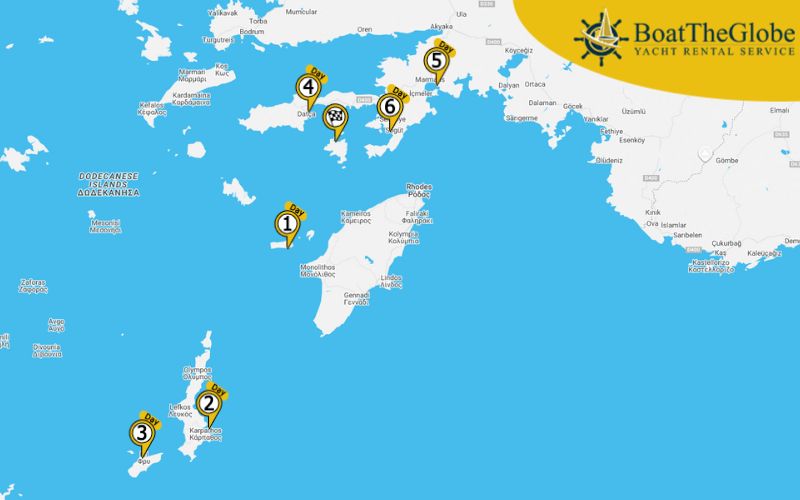
Day 1: Simi – Chalki (20 nm – Sailing time*: about 3.5 hours), Day 2: Chalki – Karpathos (30.2 nm – Sailing time*: about 5 hours), Day 3: Karpathos – Kasos (17.8 nm – Sailing time*: about 3 hours), Day 4: Kasos – Knidos (35.1 nm – Sailing time*: about 5.5 hours), Day 5: Knidos – Marmaris (24.8 nm – Sailing time*: about 4 hours), Day 6: Marmaris – Bozburun (17.8 nm – Sailing time*: about 3 hours), Day 7: Bozburun – Simi – Simi (14.6 nm – Sailing time*: about 2.5 hours)
* – an average 43 ft sailing yacht, with average weather conditions, sails around 6-7 knots per hour.
How to choose?
- If you are preparing for your first international crossing, you want a short section, with little paperwork: Kos – Bodrum or Kalymnos – Datça, Short distance, well-planned, minimal exposure to the open sea.
- If you already have charter experience, but are not looking for extremes: Rhodes – Marmaris or the 7-day Kos circuit. Varied sections, good infrastructure, flexible stops.
- You are looking for a challenge, with longer journeys, and are not bothered by the open sea: Leros – Knidos or Patmos – Bodrum. Meltemi-affected, more technical routes, greater boat experience.
- If you are short on time, but want to change countries: Kos – Bodrum one-day crossing.
The key to the decision is always three factors:
your experience, the season (Meltemi!), and how much open sea you want.
Sailing from Greece to Turkey FAQ
What is the fastest crossing from Greece to Turkey?
One of the shortest classic routes is the Kos-Bodrum crossing (around 10-15 nm), which can be completed in a few hours in good weather.
When is the best time to cross?
Generally, May-early June and September-early October are the most balanced; in July-August the Meltemi is often strong, which can be stressful for beginners.
Is the crossing suitable for beginners?
Yes, if you choose a short route, set off in a stable weather window, and have a backup plan (alternative port or extra day) in case of strong winds.
Where can you officially enter Turkey by boat?
You can typically only enter Turkey at a designated clearance port, where passport control and ship papers/crew list processing take place.
What should I look out for when crossing the border?
Have all ship and personal documents with you, check in advance which port handles entry, and allow for the time required for the paperwork (especially in peak season).
Which route is good if I want comfortable marinas?
Bodrum and Marmaris are particularly marina-rich destinations, with good catering and charter-friendly services.
What is the biggest weather risk in summer?
The Meltemi (northern wind) can often reach 20-30 knots in July-August, which builds waves and reduces comfort, especially in more open sections.
Is it worth changing countries as a one-day program?
Yes: with a short crossing (e.g. Kos-Bodrum) you get the “experience of changing countries” with minimal travel time, but you still have to deal with formalities.
If you don’t want to deal with paperwork, ports and route planning, you can leave it all to us. Just fill out the form below, request a quote, book a yacht and set off on an unforgettable adventure.
