


Are you planning to sail from Turkey to Greece? Sailing from Turkey to Greece is not just a border crossing, but a real change of maritime experience. In short distances, culture, atmosphere and rules change – while this corner of the Mediterranean offers a suitable route for everyone from beginners to advanced sailors. This guide is for those who want to plan a safe, conscious and enjoyable Turkish-Greek crossing. We will show you which route is ideal when, for whom and where the adventure becomes a real open sea challenge. 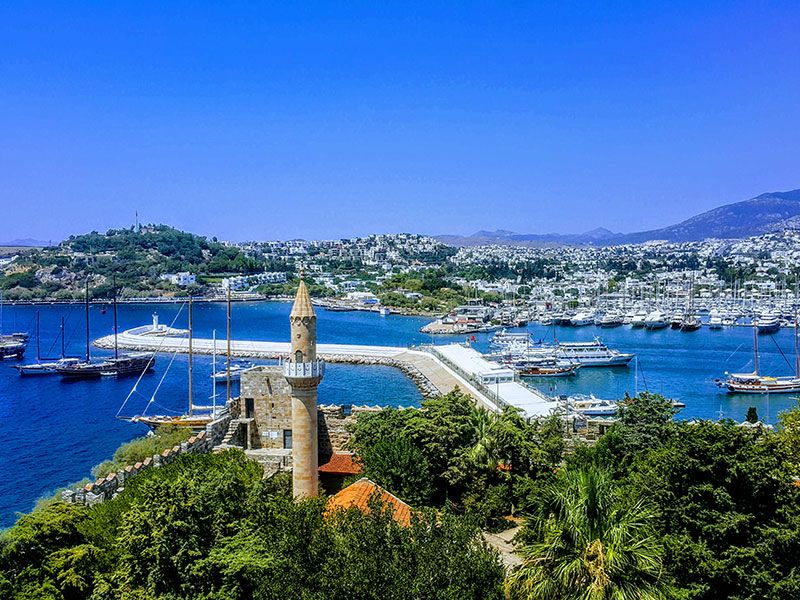
Here’s what the article will cover:
- How far is it, and how long does it take to sail from Turkey to Greece on a private yacht?
- Which month is best for sailing from Turkey to Greece?
- Important things to know when sailing from Turkey to Greece
- Ports of departure from Turkey and arrival in Greece
- Sailing from Turkey to Greece: sailing itineraries
How far is it, and how long does it take to sail from Turkey to Greece on a private yacht?
The proximity of the Turkish coasts and the Greek islands is always surprising. Kos or Symi, for example, are so close that with an experienced captain and good wind you can cross in under 2 hour – almost like hopping to the other shore. However, if you depart from Bodrum or Marmaris toward Rhodes, the leg is longer: roughly 20-30 nautical miles, which usually takes 3-6 hours. Those who venture further, for example into the deeper waters of the Dodecanese or to the Cyclades, should expect night crossings and multi-day passages. Weather adds a lot to the experience: a calm sea is a real gift, while the Meltemi can thoroughly test a sailor. Shorter trips feel like easy island-hopping, whereas the longer ones become true sea-exploration voyages – both have their charm depending on what kind of adventure you seek.
Which month is best for sailing from Turkey to Greece?
Definitely in spring or autumn, especially for beginner sailors. If you’re setting off on a sailing adventure from Turkey to Greece, the weather and sea conditions will determine everything: it can turn into a smooth, calm cruise or a real challenge.
Spring (April-June)
The sun is already pleasantly warm without being scorching, and the sea is usually calmer than in the height of summer. There’s no overcrowding in the marinas either, so you’ll easily find a spot for a relaxed evening. The wind is just right at this time: not too strong, not too light – if you’re a beginner, you couldn’t pick a better time to start.
Summer (July-August)
This is the true high season, when every island is buzzing, but it’s also when the famous Meltemi shows its strength. This persistent north wind can blow for days at 25-30 knots. If you’re experienced, you’ll love the challenge and the speed; if you’re still learning the ropes, it can be exhausting. In return, you get long, hot days full of atmospheric tavernas, lively marinas.
Autumn (September-October)
In my opinion, this is the best compromise: it’s still warm enough, the Meltemi is gentler, and the sea is perfect for swimming. Marinas and bays empty out after the summer peak, so you can experience the islands in a more intimate, relaxed atmosphere.
Winter (November-March)
If you set sail in winter, be prepared for a completely different world. Temperatures drop, the sea becomes rougher, and storms are more likely to appear. Most marinas fall into a near-hibernation, and tourists disappear. Of course, it has some charm, but this is more for experienced private boaters, not a classic charter period.
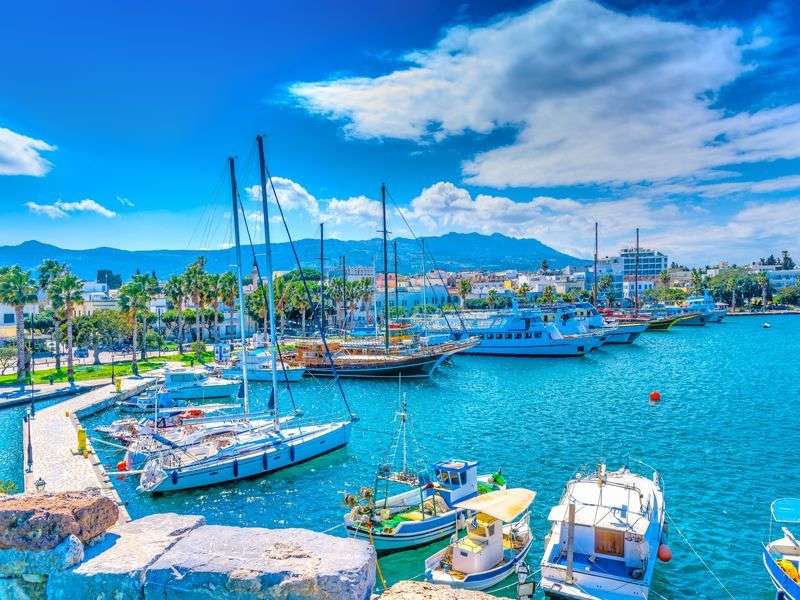
Important things to know when sailing from Turkey to Greece
- Customs and paperwork: Since you are crossing from Turkey (non-EU) into Greece (EU/Schengen), official entry in designated ports with customs and border checks is required. It’s important that passports, crew list and the boat’s papers are in order. Many underestimate how much time this process can take.
- Fees and marina costs: Greek marinas and ports are generally more expensive than Turkish ones. In Turkey you can often bargain on mooring fees, while in Greece prices are usually firmer, and water or electricity are often charged separately.
- Currency: The official currency in Turkey is the Turkish lira, and in Greece it’s the euro. Prices (food, fuel, mooring) are generally lower on the Turkish side. As you cross into Greece, expect higher costs – especially in restaurants and marina services.
- Fuel and provisions: Diesel is mostly cheaper in Turkey, so many sailors prefer to fill up there. Groceries are also more affordable on the Turkish coast, although it would be a shame to miss the fantastic local products of the Greek islands.
- Connectivity and SIM cards: Roaming fees between Turkey and the EU can add up quickly. If you plan to stay longer, it’s worth buying local SIM cards for both sides.
- Timing your arrival: Try to arrive at an official entry port during working hours. If you arrive outside of those hours, authorities may not be available and you might have to wait until the next day.
- Cultural atmosphere: Beyond the paperwork and costs don’t forget that both sides have their own charm. Turkey tends to offer a friendly, cheaper and lively bazaar-marina atmosphere, while Greece offers the classic island vibe, whitewashed houses and millennia-old history. That contrast is what makes the journey memorable.
Ports of departure from Turkey and arrival in Greece
All entry into Greek territory, and all return to Turkey, are subject to passport control and entry procedures.
Bodrum → Kos
If you depart from Bodrum, Kos is one of the simplest and most beautiful Greek destinations. The sail is short, only a few miles, and you’ll feel the holiday mood while still on the water. Kos town is full of life: strolling by the harbor you’ll find tavernas, cafés and small shops, while the ancient Asklepion ruins in the background remind you of the island’s history.
Marmaris → Rhodes
Sailing from Marmaris to Rhodes is a slightly more serious trip, but worth it. Rhodes is one of the largest islands of the Dodecanese, and the old town with its cobblestone streets and fortifications is simply awe-inspiring. The marina area is full of life, the cafés, restaurants and bars all suggest that something is happening here every day.
Fethiye → Symi
The charm of Symi grabs you as you approach the harbor. The pastel-colored houses rise above the water, and you immediately feel the island’s slow, calm rhythm. It’s not as crowded as Kos or Rhodes, so here you really have time to enjoy the quiet and the scent of the sea. The harbor is small but magical, and waterfront dinners are always among the highlights of sailing for me. This is a rare and long open water section, not ideal for beginners, but rather an advanced level crossing.
Datça → Symi
If you depart from the Datça peninsula, Symi is only 12 nautical miles away – almost a lightning-fast crossing. This short distance is perfect if you want a calm, comfortable day at sea.
Kuşadası → Samos
Setting off from Kuşadası towards Samos is always exciting because the island welcomes you with green mountains and traditional villages. From the boat, you can already see the island’s character from afar, and upon arrival the Samos marina meets every need. It’s worth trying the famous muscat wine and strolling the little streets – for me, this short crossing always starts with a bit of adventure that lasts all day. Charter a boat to Turkey and set off to explore the most magical coastlines of Turkey and Greece – leave the rest to the wind and sun.
Sailing from Turkey to Greece: sailing itineraries
7-day sailing itinerary: Sailing from Turkey to Greece
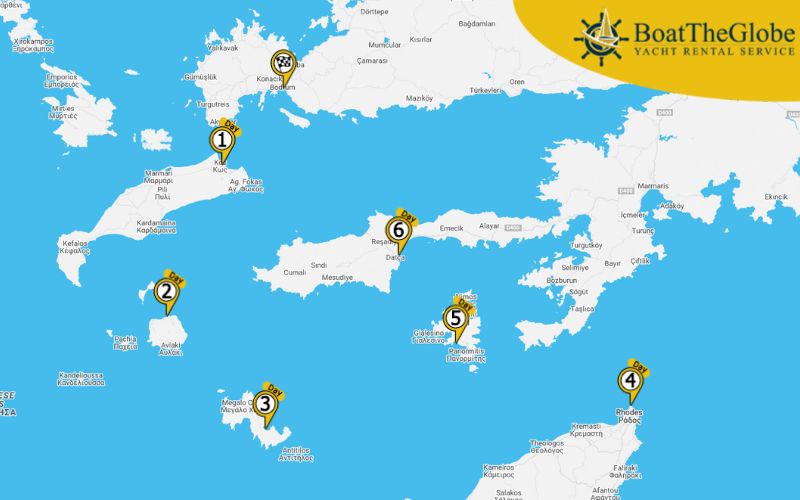
Day 1: Bodrum → Kos
10.3 nm, sailing time: 2 hours. Depart Bodrum for a short but exciting crossing to Kos. You’ll smell the sea and feel the play of the wind already on the boat – it always feels like the first moments of freedom. Walk around Kos town: the marina area is full of cafés and tavernas, and the Asklepion ruins will transport you back to ancient Greece. This short leg is perfect to get into the rhythm of sailing and to unwind from pre-departure excitement.
Day 2: Kos → Nisyros
17.8 nm, sailing time: 3 hours. The next day head to Nisyros, the volcanic island that seems to take you into another dimension. Anchor in Mandraki harbor, then explore the crater and the charming villages.
Day 3: Nisyros → Tilos
15.1 nm, sailing time: 3 hours. Tilos with its green bays and peaceful villages, offers a real refuge. Swim in the crystal-clear water, walk the streets of Livadia, and enjoy how time almost stops. This island is perfect for a slow, relaxing afternoon after a morning sail.
Day 4: Tilos → Rhodes
24.8 nm, sailing time: 4 hours. Upon arrival in Rhodes, the atmosphere changes immediately: a larger island, historic old town, bustling marina. Walk the cobbled streets, see the fortifications, and let the island’s history wash over you. In the evening, sipping a local drink in a bar by the harbour, you’ll quickly understand why this island is so magical.
Day 5: Rhodes → Symi
20.0 nm, sailing time: 3 hours Symi is like a painting come to life: pastel-colored houses, small bays and a charming harbor. Anchor in Gialos Harbor, wander the streets, and taste fresh seafood at a waterfront taverna. Smaller and quieter, you can feel the Mediterranean rhythm in every moment.
Day 6: Symi → Datça
11.9 nm, sailing time: 2 hours A short crossing to Datça, where the harbor’s small-town charm and nearby beaches immediately wash away all fatigue. Turkish hospitality is always friendly, and sitting in local cafés you’ll feel as if you’ve known the island for years. This short leg is a pleasant transition back from Greek waters.
Day 7: Datça → Bodrum
24.8 nm, sailing time: 4 hours Close the loop in Bodrum. Explore Bodrum Castle, stroll the marina, buy small souvenirs, and celebrate the 7-day adventure with a relaxed waterfront dinner. Looking back at the islands from the boat in the light of sunset, every little detail – the ripple of the sea, the bustle of the harbors – feels like the end of a long, unforgettable story.
Sailing route plan from Turkey to Greece
Ideal time: early May, October. Recommended for experienced captains, with a stable crew, knowledge of the Meltemi. Recommended level: Intermediate, advanced. Open sea sections: yes (long, exposed).
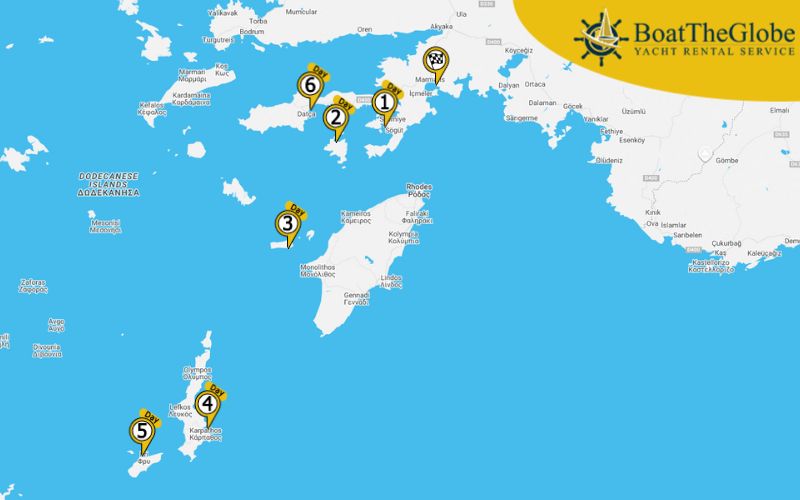
Day 1: Marmaris → Bozburun (Turkey), 14.6 nm, sailing time: 2-3 hours, Day 2: Bozburun → Symi Bay (Greece), 17.8 nm, sailing time: 3 hours, Day 3: Symi Bay → Chalki (Greece), 20.0 nm, sailing time: 3-4 hours, Day 4: Chalki → Karpathos (Greece), 30.2 nm, sailing time: 5 hours, Day 5: Karpathos → Kasos (Greece), 17.8 nm, sailing time: 3-4 hours, Day 6: Kasos → Knidos (Turkey), 35.1 nm, sailing time: 6 hours, Day 7: Knidos → Marmaris (Turkey), 24.8 nm, sailing time: 4 hours
How to choose?
A good choice is not about the most miles, but about the route that suits your skills, the season and the comfort zone of the crew. The border region of Turkey and Greece offers an exceptionally wide range of options in this regard – but only for those who choose consciously.
If you want to experience this route without stress, we can help you find the right boat even with skipper. Just fill out the form below, request a quote, book a yacht, and you can set off on an unforgettable adventure.
