


Are you planning a Balearic Islands sailing trip or would you like to start your Spanish sailing routes from here? The Balearic Islands are one of the most versatile sailing destinations in the Mediterranean. Short, sheltered stretches, easy-to-reach ports and crystal-clear bays await beginners, while open sea crossings and northerly winds offer a real challenge for experienced sailors. This guide will not only inspire you, but also help you realistically decide which route, which island and which season best suits your skills, your crew and your expectations.
Here’s what the article will cover:
- 5 reasons why the Balearic Islands is good for sailing?
- What is the best month to sail Balearic Islands?
- How can you get to the Balearic Islands from abroad?
- Where can you sail to from the Balearic Islands? – ports and islands
- Sailing in the Balearic Islands – itineraries
5 reasons why the Balearic Islands are good for sailing?
- Reliable winds and pleasant weather
The winds are mostly predictable and beginner-friendly, but on the northern coasts (Mallorca/Menorca) the Tramontana can periodically strengthen quickly – in these cases it is worth choosing a protected bay or harbor. - Varied and beautiful landscapes
The diverse natural beauty of the Balearic Islands-from rugged coastlines to untouched coves-makes you feel as if you were wandering through a breathtaking open-air gallery. Menorca‘s rugged, untouched cliffs are so wildly romantic that they make even the most experienced hiker stop. And Formentera’s bays are so clear that they invite you to swim, as if you’ve fallen into some secret underwater paradise. Mallorca with its dramatic rocky coasts and secluded bays is a true artistic spectacle, Ibiza somehow creates a balance between tranquility and partying. So, when you get on a boat, every day you will see a new sight that will make you want to take the helm. - Short distances between islands
The proximity of the Balearic Islands means you can get from one island to another in just a few hours – ideal for planning shorter sailing routes. However, it is also worth considering the weather conditions and current sea states. This way you won’t be drowning in long crossings and will have more time to get to know the unique atmosphere of each island. This quick change is what makes the Balearic Islands so exciting for sailors. - Modern ports and excellent services
Today’s sailing is not just about being at sea – it’s also about the experience of stopping in port. The Balearic Islands offer an incredible variety of options: luxury marinas, friendly, family-friendly ports, all filled with all the essentials. Fuel? Yes. Boat repairs? Yes. Comfortable restaurants? Plenty. Rent a boat in the Balearic Islands and enjoy the waves taking you to the most beautiful bays of the island – in the perfect balance of tranquility and adventure. - Rich culture and vibrant island life
The Balearics are not only loved for their natural beauty, but because every port is a little cultural adventure. You drop anchor and immediately plunge into island life: colorful markets, fresh seafood, local wines, street musicians, festivals – it’s all a special experience that adds an extra magic to your holiday.

What is the best month to sail Balearic Islands?
The short answer is: from late spring to early autumn. The weather is most balanced between May and September, with ideal sea conditions and guaranteed sunshine. Many people find the best value for money and peace in May, June or September, when the balance between peace and experience is best.Sailing in the Balearic Islands is not only attractive because of the beautiful scenery – but also because you can go sailing almost at any time. The archipelago has a classic Mediterranean climate: lots of sunshine, mild winters, warm summers and pleasant winds. But it doesn’t matter when you set off. Each season brings a different atmosphere – sometimes it’s all about relaxation, other times it’s more about the real, sporty side of sailing.
Spring (March – May):
If you ask me, spring is one of the best times to visit – especially in May. There are no crowds of tourists, the ports are quiet, nature is in full swing, and there is something incredibly peaceful about being the first to splash around at anchor in the morning. The days are pleasantly warm (18-24°C), the winds are predictable but not too strong. It’s ideal if you want to relax and explore the islands in peace.
Summer (June – August):
The summer season is particularly popular as the temperatures are ideal, the sea is warm, there are many festivals and parties, and most services are active during this period. The temperature is often around 35°C, the sea is almost swimming pool temperature. Summer can be good for beginners due to the stable weather, but during peak season, traffic and port congestion are high – so it requires more advance planning. If you come during this period, book a berth in advance – especially in Ibiza and Mallorca, they fill up quickly.
Autumn (September – November):
There’s something especially beautiful about the Balearic Islands in autumn. The days are still long, the water is warmer than you might think in September, and most of the boats have already headed home. If you’re into serious sailing, this is the time. Around October and November, the winds pick up, making it more suitable for advanced sailors. Meanwhile, the islands are still fabulous, but they’re not as crowded with tourists.
Winter (December – February):
Winter? Quiet. Peace with a capital letter. It’s true that many places close at this time and the days are shorter, but if you’re not looking for the excitement of summer, but rather the closeness of nature, the starry sky from the deck, and the tranquility of deserted bays – then it’s worth getting on a boat in winter too. 10-15°C days, stronger winds, changeable weather – not for beginners, but wonderful in its own way.
How can you get to the Balearic Islands from abroad?
If you’re heading to the Balearic Islands, flying is clearly the most practical and fastest option. Mallorca, Ibiza and Menorca have their own airports, so if you’re not aiming for Formentera (which you can only get to by water), you can literally be there in a couple of hours, with a cold sangria in hand.
Palma de Mallorca Airport (PMI) is the largest airport in the archipelago. It’s like a bustling gateway to the Mediterranean dream – and that’s no exaggeration. It has direct flights to all of Europe, from major cities to smaller airports.
Ibiza Airport (IBZ) is like an aviation festival in the summer: planes come and go, bringing both party-goers and those longing for quiet coves. The number of seasonal flights increases significantly at this time, so it’s not difficult to find a seat on a plane.
Menorca Airport (MAH) already exudes a quieter atmosphere, but all the more friendly. Mainly domestic and If you’re heading to the Balearic Islands, flying is clearly the most practical and fastest option. Mallorca, Ibiza and Menorca have their own airports, so if you’re not aiming for Formentera (which you can only get to by water), you can literally be there in a couple of hours, with a cold sangria in hand.
Palma de Mallorca Airport (PMI) is the largest airport in the archipelago. It’s like a bustling gateway to the Mediterranean dream – and that’s no exaggeration. It has direct flights to all of Europe, from major cities to smaller airports.
Ibiza Airport (IBZ) is like an aviation festival in the summer: planes come and go, bringing both party-goers and those longing for quiet coves. The number of seasonal flights increases significantly at this time, so it’s not difficult to find a seat on a plane.
Menorca Airport (MAH) has a quieter atmosphere, but it’s also friendlier. It mainly serves domestic flights and a few European ones – perfect if you’re looking for a less crowded, more authentic island.
If you’re coming from Europe, you’ve got it easy: Ryanair, easyJet, Vueling, Jet2 – just a few of the many names that fly passengers to the Balearic Islands every day. From London, Paris, Berlin, Amsterdam or even Rome, it’s just a few hours away.
From outside Europe, it’s a bit more complicated, but not at all difficult. It’s usually easy to get there with a big European transfer (Madrid, Barcelona, Frankfurt, London). If you time your connections well, you can even jump from the airport to the ship in a single day – and the adventure can begin.
Send feedback
how many European flights operate here – perfect if you are looking for a less crowded, authentic island.
If you are coming from Europe, you have it easy: Ryanair, easyJet, Vueling, Jet2 – just a few names from the many that fly passengers to the Balearic Islands every day. From London, Paris, Berlin, Amsterdam or even Rome, the journey is just a few hours.
From outside Europe, it is a little more complicated, but by no means complicated. It is usually easy to do with a large European transfer (Madrid, Barcelona, Frankfurt, London). If you time your connections well, you can even jump from the airport to the ship in a single day – and the adventure can begin.
Where can you sail to from the Balearic Islands? – ports and islands
Posidonia oceanica (seagrass meadow) is found in many places in the Balearic Islands. This is a protected habitat, so it is forbidden to anchor in such a way that the anchor and chain plow the grass. In practice, this means that in many bays a field of buoys has been created (here you have to stand on a buoy), or you can only anchor on sand patches, or in certain zones there may be restrictions/bans.
What should you do in practice?
If the water is dark blue-green → do not anchor.
If there is a field of buoys → stand on a buoy, do not bargain.
If you are unsure → ask or moor.
Why is this important to you? In Mallorca and Menorca, buoying is mandatory in many bays and there are active drone and water police inspections, where fines are issued regularly. In the Cabrera National Park, entry and overnight stays are subject to a permit, anchoring is prohibited, only designated buoys can be used. There is no “warning” for violations, there is an immediate sanction. Ibiza is one of the most strictly controlled islands where the Posidonia fields are digitally mapped and buoy fields are densely located. Anchoring on grass is quickly and heavily fined. Formentera has the strongest protection, it is a specially guarded marine reserve. Anchoring is prohibited in many places, you can only stand on a buoy.
Ibiza
If you’re sailing towards Ibiza, don’t focus only on the nightlife. The island’s daytime charm is worth exploring too: the Cala Comte with its orange-hued sunsets and the crystal-clear waters of Cala Saona are perfect for anchoring or sunbathing. At Marina Ibiza and Botafoch marinas, it’s ideal to restock your supplies, check your engines, or try a quick seafood meal from the deck. Practical tip: always check local anchoring rules and wind direction when dropping anchor to ensure your boat stays safely in place. Ibiza offers a perfect balance between relaxation and vibrant marina life-plan your day to enjoy both. yacht hire Ibiza
Mallorca
On Mallorca, every sailor can find something to enjoy. The lively Puerto Portals is perfect for an evening out, while the peaceful Port de Sóller offers serene morning anchoring with sunrise over the mountains. The northern rocky coastline presents a challenge for experienced sailors, whereas the southern side is safe even for beginners. Tip: always check local currents and wind conditions before choosing a marina and use GPS for safe navigation. Palma is perfect for a short marina stop-markets, tapas bars, and local sights are just a splash away from your boat. yacht rental Mallorca
Menorca
Menorca is the island of tranquillity: it’s best to approach slowly and anchor carefully. Hidden coves like Cala Macarella or Cala Mitjana are perfect for anchoring, swimming, and sunbathing, with crystal-clear waters and shaded areas. Practical tip: always check the seabed type before anchoring and carry backup anchoring equipment. Rock gently under the starry sky at night and wake up to the sound of your anchor splashing in the morning-this is the essence of sailing. yacht charter Menorca
Ciutadella
Ciutadella is Menorca’s true heartbeat: the natural harbor provides perfect shelter for your boat. Tip: before exploring the town, always check your boat’s equipment and supplies, and allow enough time for marina manoeuvres. Small cafés and stone houses line the shore, making it worth preparing for short walks and photo opportunities while your boat remains safely anchored.
Maó-Mahón
Mahon is Menorca’s eastern gateway and a natural wonder: arriving in its deep harbor is almost a spiritual experience. Practical sailing tips: always check water depth within deep-water channels and follow local marina guidance for safe manoeuvring. The coastal bars and tapas spots are perfect for a short break, boat maintenance, or enjoying local culture, while your boat stays securely anchored in the deep harbor.
How to choose?
The Balearic Islands are not “one” sailing destination, but several levels in one place. The right choice is not about the longest route, but about the experience matching your knowledge – and thus being truly memorable
- If this is your first time sailing at sea:
Choose the Ibiza-Formentera area. Short days, little open water, lots of success. - If you are already confident maneuvering in port: Mallorca is the ideal next step. More wind, more tactics, but still well-planned.
- If you are looking for a challenge and open sea: consider a Menorca-Mallorca crossing – only with the right experience and weather window.
Sailing in the Balearic Islands – itineraries
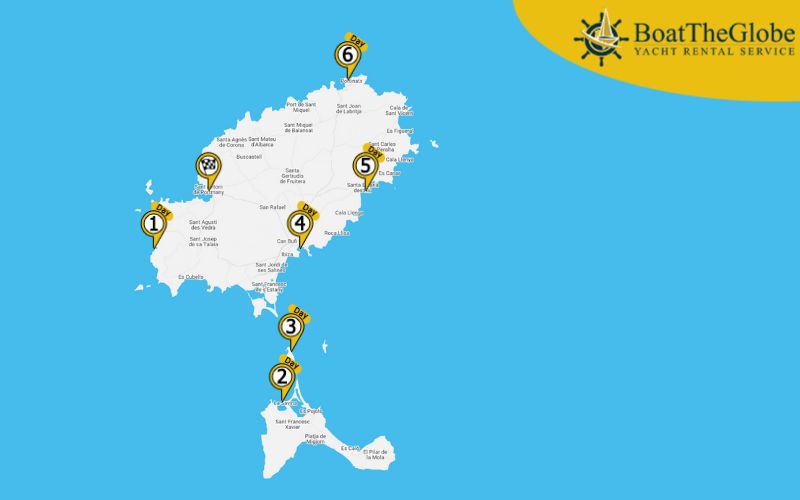
Sailing in Ibiza
Short distances, many anchorages, little navigation stress. Ideal period is May-June, September. Recommended level: Beginner, intermediate-advanced. Open sea sections: no (short, well-protected crossings).
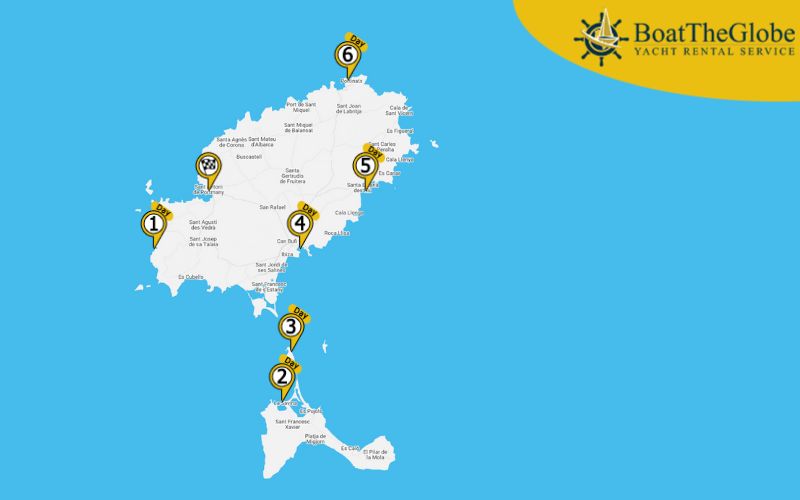
Day 1: Sant Antoni – Cala Vedella
7.0 nm, sailing time: approx. 1 hour With the first breezes of the day, you leave the bustling port of Sant Antoni and head for Cala Vedella – a small, huggable bay where the sea calms down as if it has always wanted to live here. The boat almost blends into the landscape. If you drop anchor before sunset, kick off your shoes, grab your SUP and paddle out into the silence. Soft music plays from the shore, the air is filled with the scent of sangria and sea salt – this is the kind of opening that only the best sailing weeks have.
Day 2: Cala Vedella – La Savina (Formentera)
17.8 nm, sailing time: approx. 3 hours Sailing to Formentera is like stepping into a slower, more colourful reality. La Savina’s harbour is calm and sunny, like a well-taken afternoon siesta. Rent a scooter and explore the world of sand dunes, lighthouses and seaside villages – but don’t forget your sunscreen, the island is brutally sunny. If you’re visiting during the Formentera Jazz Festival, a little improvised music in the evening will bring the perfect end to a perfect day.
Day 3: La Savina – S’Alga (Espalmador)
29.2 nm, sailing time: approx. 4-5 hours This is the longer leg, but Espalmador is worth the wait. An uninhabited, dreamlike island where nature dictates. There are no bars or souvenir vendors here – just you, your boat, the sand and the mud baths, which are both fun and surprisingly revitalizing. As you step out of the mud wrap and into the sea, it’s as if you’ve thrown all the noise of civilization off you. Here you’ll learn to breathe slowly again.
Day 4: S’Alga – Ibiza Town (Eivissa)
10.3 nm, sailing time: approx. 1.5 hours Now comes a bit of contrast! Ibiza Town is a unique blend of history, excitement and Mediterranean charm. Dalt Vila, the old town, with its narrow streets, spicy scents and old-fashioned shops, is like a living set for a Mediterranean film. Don’t plan too much for the evening – the Aperol Spritz will slip away like the sun setting behind the horizon. If you’re here in summer, the town is buzzing – sometimes there’s a Pride parade, sometimes a street festival, but there’s always something going on.
Day 5: Ibiza Town – Santa Eulalia (Eularia)
8.1 nm, sailing time: approx. 1 hour After a short, pleasant stretch, you’ll arrive in Santa Eulalia – an elegant, slightly understated, yet lively place. Perfect for getting in the mood or unwinding after the night before. The coastal promenade comes alive in the evening, especially in June, when the Adlib fashion festival fills the evening with illuminated palm trees and catwalks. Romantic, bohemian and subtly nostalgic – even the air here is different.
Day 6: Santa Eulalia – Portinatx
15.1 nm, sailing time: approx. 2 hours The north coast of the island is a wilder, rocky world. As you head towards Portinatx, the landscape gradually becomes more tame, but still retains the raw power of nature. The water is clear, and colorful fish zigzag under the rocks – don’t forget your snorkel! If you’re here in August, the beach turns into an open-air festival during the Village Days, where music, lights and fireworks dance on the waves.
7. Day 3: Portinatx – Sant Antoni
16.2 nm, sailing time: approx. 3 hours The last day is always a bit melancholy, but Sant Antoni makes sure that the tour ends on a worthy note. Sunset here is not an event, but a ritual. Sitting on the terrace of Café del Mar or Mambo, swaying to the rhythm of the music as the sun sinks into the sea – that’s the moment when you know you’ll be back. The sailing week is over, but the smell of the sea stays with you for a long time.
Sailing itinerary around Mallorca
Short distances, many anchorages, little navigation stress. Ideal period is May-June, September. Recommended level: Beginner, intermediate-advanced. Open sea sections: no.
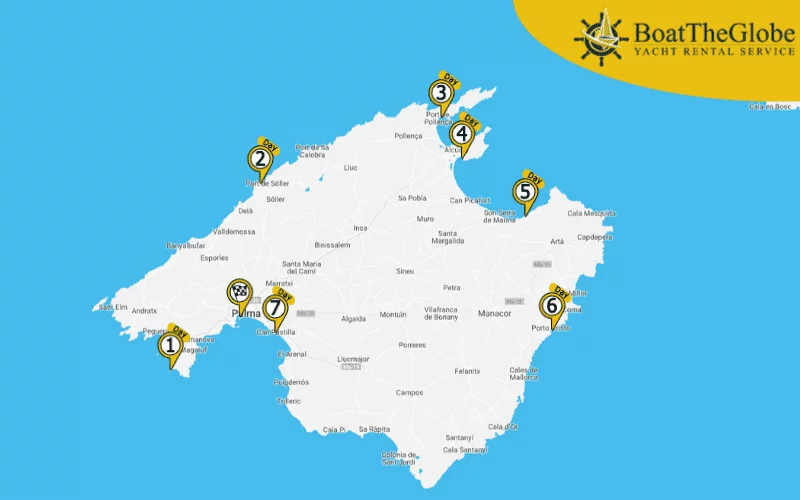
Day 1: Palma de Mallorca – El Toro (12.5 nm – Sailing time*: about 2 hours), Day 2: El Toro – Port de Sóller (4.4 nm – Sailing time*: about 1 hour), Day 3: Port de Sóller – Port de Pollença (35.5 nm – Sailing time*: about 5.5 hours), Day 4: Port de Pollença – Alcúdia (12.3 nm – Sailing time*: about 2 hours), Day 5: Alcúdia – Colonia de Sant Pere (10.5 nm – Sailing time*: about 2 hours), Day 6: Colonia de Sant Pere – Porto Cristo (26 nm – Sailing time*: about 4 hours), Day 7: Porto Cristo – Ca'n Pastilla – Palma (50.8 nm – Sailing time*: about 8 hours)
* – an average 43 ft sailing yacht, with average weather conditions, sails around 6-7 knots per hour.
7 days Menorca sailing trip
A real sea experience, less crowds, more challenge. Ideal time is June and early September. Recommended level: Advanced. Open sea sections: yes (long offshore crossings)
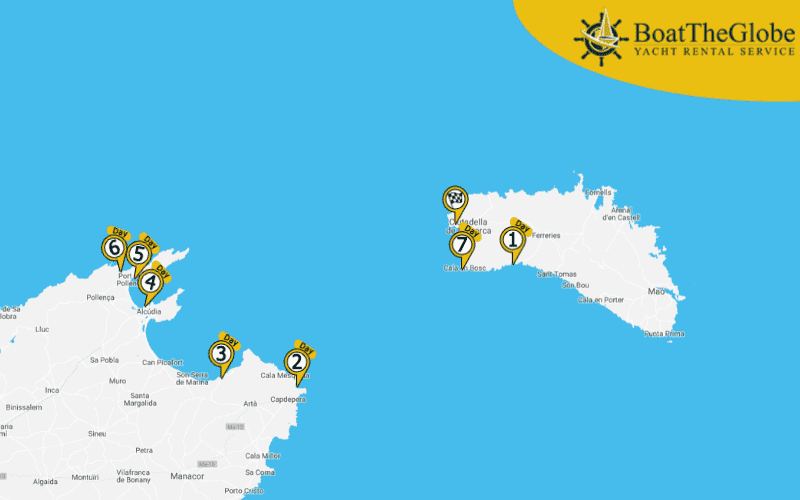
Day 1: Ciutadella – Cala Galdana (11.3 nm – Sailing time*: about 2 hours), Day 2: Cala Galdana – Cala Ratjada (21.9 nm – Sailing time*: about 3.5 hours), Day 3: Cala Ratjada – Colonia de Sant Pere (14.3 nm – Sailing time*: about 2.5 hours), Day 4: Colonia de Sant Pere – Alcúdia (10.5 nm – Sailing time*: about 2 hours), Day 5: Alcúdia – Port de Pollença (12.3 nm – Sailing time*: about 2 hours), Day 6: Port de Pollença – Cala Sant Vicenç (16.1 nm – Sailing time*: about 2.5 hours), Day 7: Cala Sant Vicenç – Cala en Bosch – Ciutadella (42 nm – Sailing time*: about 6.5 hours)
* – an average 43 ft sailing yacht, with average weather conditions, sails around 6-7 knots per hour.boat rental Balearic Islands
Sailing in the Balearic Islands FAQ
When is the best time to sail in the Balearic Islands?
The most balanced period is usually May-June and September: pleasant temperatures, fewer crowds, more stable sailing. July-August is the peak season, so it is worth booking in advance.
Which Balearic Island is best for beginners?
Ibiza-Formentera offers many short sections, more sheltered waters and simpler logistics, making it a particularly good entry point for beginners and families.
Which route offers more “sporty” sailing?
The north coast of Mallorca (Tramontana effect) is often windier and more wavy, so it offers more exciting trips for intermediate to advanced sailors.
What does the Posidonia rule mean in practice?
You must not drop anchor over Posidonia (seagrass) because the chain plows up the protected habitat. Many bays therefore have a field of buoys or are only allowed to anchor on a sandbank.
How do I know if I can anchor in a bay?
If you see darker, mottled fields on the bottom of the water, it is probably Posidonia – do not anchor in this case. If there is a field of buoys, stand on a buoy, and if you are unsure, ask at the local marina.
Do you need to book a berth in advance?
In high season (especially July-August, Ibiza and Mallorca) it is highly recommended, as popular marinas fill up quickly.
Are there open sea crossings in the Balearic Islands?
Yes, for example, Menorca-Mallorca or longer trips around Ibiza may have more open sections. These require a stable weather window and more routine.
Is a catamaran or a monohull better for the Balearic Islands?
For families and comfortable anchorages, a catamaran is often ideal (stable, spacious), while a monohull offers a sportier experience and “sails better” in the wind.
What is the ideal daily distance in the Balearic Islands?
For beginners, 10-25 nm is comfortable, for intermediates 20-35 nm is realistic, and for those over 40 nm it is worth planning with a weather window and alternative ports.
Request a quote, fill in the form and enjoy the experience of carefree sailing!
