


Sailing between Dubrovnik and Montenegro gives you iconic Adriatic scenery, historic coastal towns, border-crossing navigation and varied cruising conditions within one week. The route starts from Dubrovnik and continues through Cavtat, Herceg Novi, Kotor, Tivat, Budva and Bar. The one-way itinerary offers a smoother charter rhythm, while the round-trip version is more demanding and suits crews with stronger sailing experience. Successful planning depends on weather timing, border formalities and realistic decisions on the longer passages.
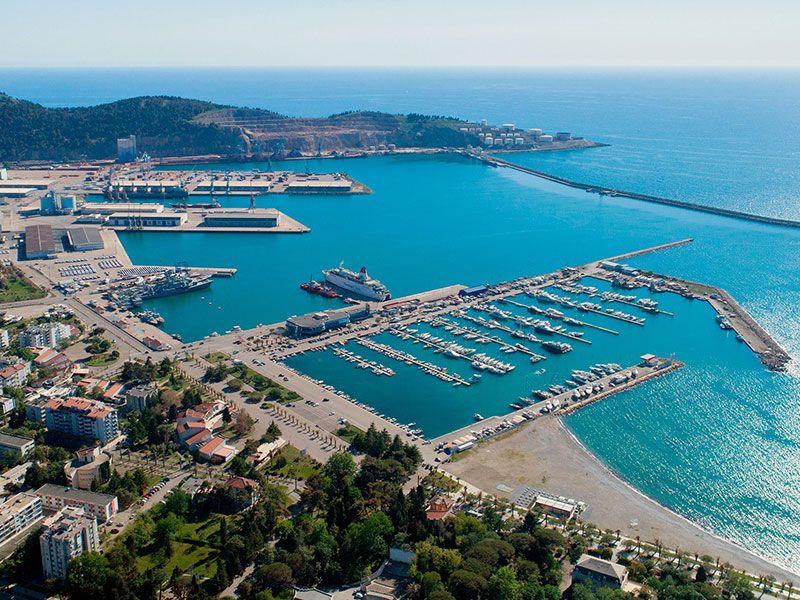
Our article gives you an overview of the following topics:
- Important facts when sailing from Dubrovnik to Montenegro
- Ports in route from Dubrovnik to Montenegro
- Sailing from Dubrovnik to Montenegro
- Marine gas in route from Dubrovnik to Montenegro
Important facts when sailing from Dubrovnik to Montenegro
When is the best time to sail from Dubrovnik to Montenegro?
Late June-August is best if you want warm water and a stable summer rhythm; May-June and September-October are ideal if you want fewer crowds and more pleasant temperatures. April to May (Spring): Average air temperatures in April are between 12°C and 20°C, and in May between 16°C and 24°C. Sea temperatures warm up to around 15°C in April and around 18°C in May. The weather is mild and pleasant with steady winds, ideal for sailing. June to August (Summer): Air temperatures range between 22°C and 30°C in June and July, and between 30°C and 33°C in August. Sea temperatures reach 25°C in August. This is the peak sailing season, offering excellent conditions for water activities.
September to October (autumn): Air temperatures average between 19°C and 25°C in September, and between 14°C and 20°C in October. Sea temperatures remain pleasant, averaging 23°C in September and around 20°C in October, with steady winds. November to March (winter): Air temperatures average between 6°C and 11°C in January, with sea temperatures around 15°C. Increased rainfall and cooler temperatures are characteristic of this period.
Wind patterns
Maestral (local summer daytime wind): A northwesterly wind that prevails in the summer months, providing a refreshing breeze, ideal for sailing. Due to the topography of the Bay of Kotor, wind direction and strength can change quickly.Bora: A strong northeast wind that can occur year-round, but is more common in the cooler months. Sailors should be careful as it can cause sudden gusts and rough seas. Sirocco (Jugo): A southeast wind that brings warm, humid air, often leading to cloudy skies and precipitation. More common in autumn and spring. Check the sailing conditions and wind rose diagram of Montenegro.
How long does it take to sail from Dubrovnik to Montenegro
The sailing time from Dubrovnik, Croatia to Montenegro depends on the route, the type of ship, the weather conditions and the exact destination in Montenegro.
Dubrovnik (from the port of Gruz) to Herceg Novi (the closest Montenegrin city):
The distance is 35 nautical miles, which is around 5-6 hours by sailboat, or 1,5-3 hours by motorboat, depending on wind conditions.
Dubrovnik (from the port of Gruz) to Kotor:
The distance is around 45 nautical miles, which is around 6-7 hours by sailboat, or 2-3 hours by motorboat.
Should I choose a one-way or round trip?
If you want a shorter route, which is easier to complete in the summer due to the wind, then opt for a one-way trip. One-way drop-off is only available on some fleets; if you want to drop off in Dubrovnik, please discuss this when requesting a quote, as the one-way fee and logistics (returning the boat) can be significant. If you rent a boat with a captain for a one-way trip, you will need to include the time until the captain sails back to base in the rental time.
The round trip is more difficult, because you will definitely be sailing half of the way against the wind. In summer, the last day is the hardest, as you have to sail more than 90 kilometers in a northwesterly direction, going against the maestral. In spring and autumn, the alternation of Bora and Sirocco can cause surprises both on the way there and back. Therefore, we recommend this route if you want to spend more time at sea and are not afraid of a little challenge. In the pre-season and post-season, plan to only undertake the long leg (e.g. Budva-Dubrovnik) when the forecast is stable, and have an intermediate refuge port (e.g. Herceg Novi area) as a plan B. Its advantage over the one-way route is that the return route is clear even outside the high season.
How to choose a route between Dubrovnik and Montenegro?
- If you want a relaxed, spectacular week with lots of stops: choose the one-way Dubrovnik → Montenegro route. Less “forced sailing”, more sightseeing and relaxation.
- If you are looking for more sailing and challenge: choose the round trip route. The return trip is often more difficult (due to wind/direction), so more routine and better weather strategy are needed.
- If you travel in high season (July-August): expect busier ports and higher fees, so book in advance and leave early on longer days.
- If you go in pre- or post-season (May-June, September-October): Crowds and temperatures are more pleasant, but winds can be more fickle – have a plan B and shorten the leg.
Entering Montenegro on a chartered yacht
If you wish to cross the border during the charter period, your chartered yacht must have a valid permit for the waters of each country and you will need to complete the border crossing at both the exit and entry ports. For water border crossings, you will need to present the crew/passenger list, valid personal and ship documents, and insurance valid for the country, as well as maritime administration (fee required). You must complete the border crossing in Dubrovnik or Cavtat in Croatia and in Zelenika (Herceg Novi Bay) in Montenegro, or at your port of departure.
Currencies and extra expenses
Croatia’s and Montenegro’s currency are the Euro. When planning costs, keep in mind that Montenegrin ports may charge € 50-110 per mooring during the high season. Outside the high season, you can come through with the moorings much cheaper, between €25-50. If you also want to visit the Croatian ports around Dubrovnik, count between € 60-100 per port, regardless of the season. The price of a Montenegrin navigation permit can be between 40 and 350 euros for 1 week. The price depends on the length of the boat, engine power and admin fees; this is often stated in advance in the package by the charter company. The price of food and drink in Montenegro is much cheaper, up to almost half the price in Croatia.
What to do before or after sailing in Dubrovnik?
Dubrovnik Airport is next to Cavtat, from where you can reach Dubrovnik by local bus or taxi. The bus that leaves half an hour after each flight is the cheapest. It costs €7.5. If you arrive in the morning, you will have plenty of time to look around the old town. If you’re an obsessed Game of Thrones fan, you might want to pay for a roughly 3-hour walking tour. In doing so, they present the locations used for the scenes in the series in King’s Landing. Or before taking over your hired yacht, you can also pay for a 2-hour cruise-walking tour. In this case, you will sail around the walls of Dubrovnik with one of the sailing-boats in the series. Rent a boat in Dubrovnik and experience what it feels like when everything is perfectly timed – the sunset, the sea, and freedom.
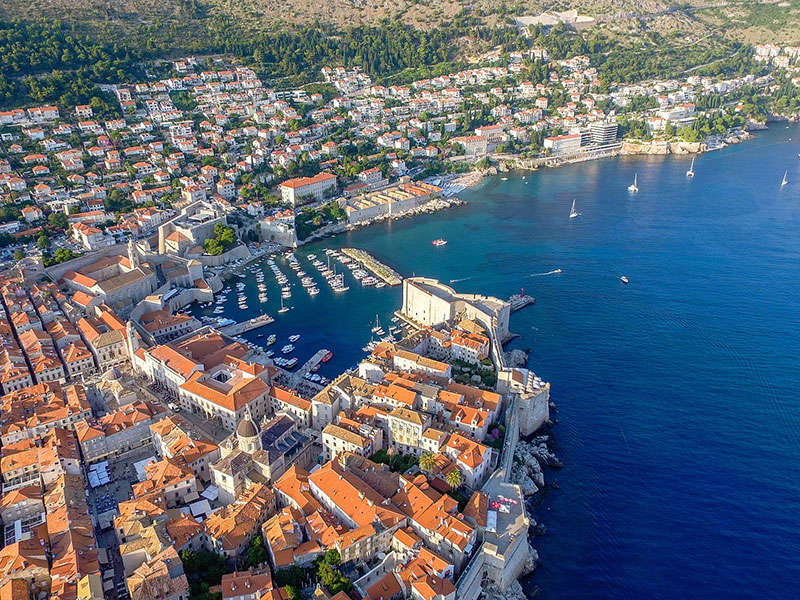
Ports in route from Dubrovnik to Montenegro
ACI Marina Dubrovnik
This well-equipped marina is 3.2 nm from the old town of Dubrovnik. As you would expect, it is open all year round. It possesses 425 berths in the water and 140 on the land. There are water and electricity supply, exchange offices, restaurants, laundries, and shower rooms. It is also a marina. The berths can accept a maximum of 60 m long yachts.
After visiting all the sights of Dubrovnik this marina can be an excellent starting point to visit the islands nearby.
Port of Dubrovnik
This port is located next to Gruz, just 1.6 nm northwest of Dubrovnik’s old town. You will find restaurants, cafes, souvenir shops, money exchange offices and even banks in the area. There are no restrictions on the length and width of the boats. The maximum draft is 11 m. Anchoring is possible: the water depth is 42 m. Due to the greater depths, it is usually worth choosing a mooring or designated solutions here; anchoring should only be done with an appropriate chain length and caution. Dubrovnik sailing, rent a boat Dubrovnik sailboat rental Dubrovnik, bareboat charter Dubrovnik, motor yacht charter Dubrovnik, catamaran charter Dubrovnik, luxury yacht charter Dubrovnik
Port of Budva
This protected port is also known as Dukley Marina Budva. It has 300 berths and can accommodate boats up to 40 metres in length. The maximum depth is 4 metres. If you get hungry, there is a bar and a restaurant at the site of the port. The excellent services include a laundry, a refuelling station, and maintenance. Budva sailing, yacht charter Budva
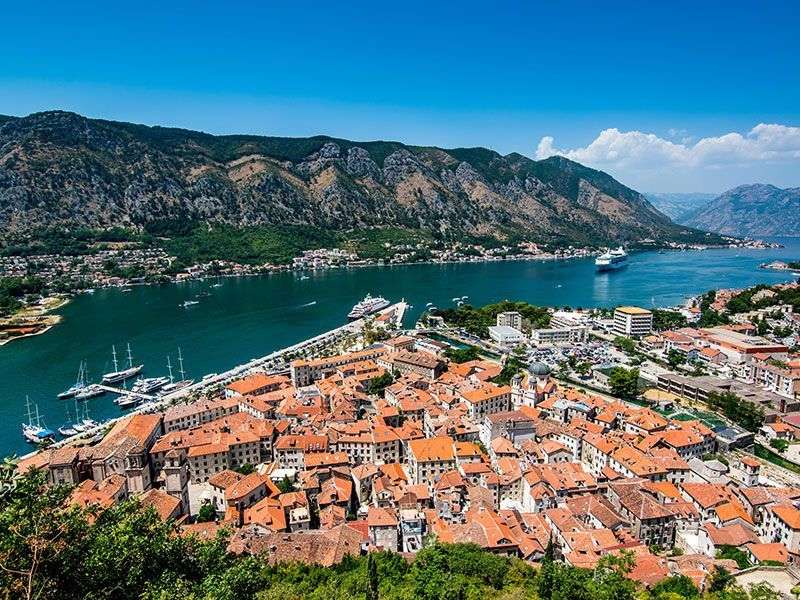
Port of Bar
It is the largest and most important port in Montenegro, in the southern part of the country. The place is also known as Luka Bar. The port consists of several sections: the port for scheduled vessels, the port for private vessels, commercial vessels, and a military port. There are more than 600 berths for vessels up to 35 metres. The depth of the seabed is 8 metres. There is a restaurant on-site, WiFi, and maintenance are available. Furthermore, a sailing school also operates in the port. Bar sailing, Rent a boat in Bar
The port of Herceg Novi
D-Marin Portonovi has 238 berths for vessels with a maximum length of 120 metres. The maximum depth water is 20 metres. There are many services offered at the port: you can refuel your vessel and choose from excellent cafés, cocktail bars, and restaurants. Herceg Novi sailing, Herceg Novi boat rental
Port of Tivat
The Porto Montenegro has helped Tivat become a prosperous town since it is visited by the richest people in the world. It has 450 berths, and it can accommodate the largest luxury yachts. The complex includes residences, restaurants, boutiques, the five-star Regent Porto Montenegro Hotel, and many other facilities. Tivat sailing, yacht charter Tivat
Port of Kotor
The port of Kotor is also known as Luka Kotor or Cattaro. It can accommodate up to 30 boats, up to 30 metres in length. The maximum depth of the seabed is 8.5 metres. The protected port offers many high-quality services. It has drinking water, electricity, a laundry, a bar, and a restaurant. You can refuel and do maintenance. Moreover, you can even get medical help if needed. Kotor sailing, rent a boat in Kotor
Sailing from Dubrovnik to Montenegro
One-way sailing from Dubrovnik to Montenegro
This route can be comfortably completed in a week, with plenty of time for sightseeing (Kotor, Tivat, Budva) and beach time in addition to the daily distances. Pay attention to border and port administration (Zelenika/Bar), as well as variable wind speeds in the Boka Bay due to the terrain. Recommended level: beginner-intermediate Open sea sections: yes ((short, more open trips near the coast; not multi-day offshore trips)
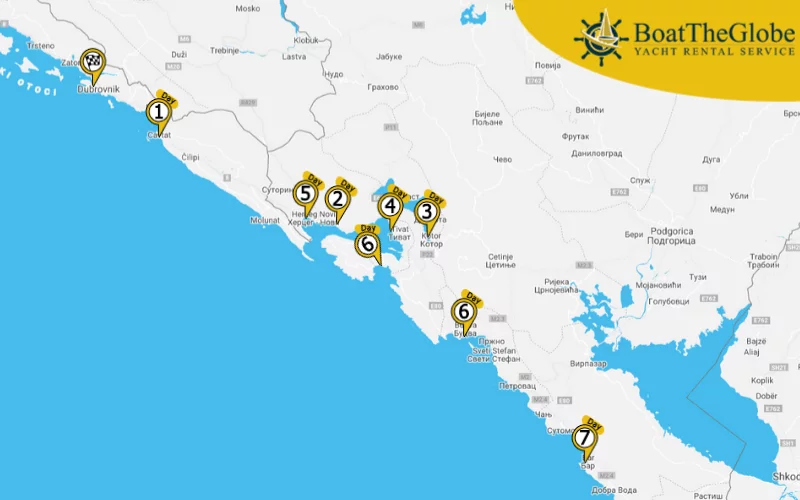
Day 1: Dubrovnik (ACI Marina Dubrovnik) – Cavtat (12.4 nm – Sailing time*: about 2 hours)
Starting west from the deep bay of the ACI Marina in Dubrovnik, sailing south-southeast, you arrive in Cavtat. If you are interested in art and culture, we recommend the former residence of the Croatian painter Vlaho Bukovac, which has been converted into a museum. You will also find the Racic Mausoleum on the hill of the small town, with great views of the Adriatic Sea.
Day 2: Cavtat – Zelenika (24.0 nm – Sailing time*: about 4 hours)
You must meet the check-in requirements, thus, Zelenika is your first stop. Once you’ve done the formalities in the port, be sure to look around the quiet little village. Also, visit the sunny beach.
Day 3: Zelenika – Kotor (13.5 nm – Sailing time*: about 3 hours)
Leaving Zelenika in an easterly direction, and then following the narrow northern strait, heading east-southeast, you arrive at the main port of Kotor. Due to the winds blowing back and forth in the bay, this is a bit more difficult section than before. If you feel like a tiny detour, approach the sailing town of Perast and the two small islands in front of it before turning east. These small islands used to be Templar pilgrimage sites.
Day 3: Zelenika – Kotor (13.5 nm – Sailing time*: about 3 hours)
In Kotor, almost all important sights are close to the port. As you pass through the Sea Gate, you will immediately reach the main square. The Clock Tower built-in 1602 with its incomplete top is worth a look. To the northeast, you will find the baroque style armoury. There are plenty of sights on the south side, don’t miss St. Tripun’s Cathedral! By offering a beautiful view with its rustic style and the rock walls towering behind it it is no coincidence that it has become the symbol of Kotor. If you are interested in the history of shipping in Montenegro, be sure to visit the Maritime Museum of Montenegro! Here you can see lots of ship models, old instruments and other nautical things.
Day 4: Kotor – Tivat (Porto Montenegro Marina) (7.9 nm – Sailing time*: about 2 hours)
After seeing the sights of Kotor, you will mainly repeat the route of the day before, but in the opposite direction. Now, however, turning south after the strait, you’re heading along the east coast to arrive at Tivat’s newest marina. The city also has two ports, in both of which you can see more and more beautiful luxury ships. The port where you arrive is also the most important ship repair yard in the area. Another interesting sight is the airport, where the end of the runway is very close to the sea.
Day 4: Kotor – Tivat (Porto Montenegro Marina) (7.9 nm – Sailing time*: about 2 hours)
Be sure to check out the city’s huge botanical garden. Here you can see countless different plants that were originally brought back by sailors sailing in the Mediterranean. Returning to the port, you will also find the Tivat Maritime Museum, where you can even see a renovated Yugoslav submarine.
Day 5: Tivat – Herceg Novi (7.3 nm – Sailing time*: about 2 hours)
Herceg Novi has become a popular tourist destination due to its 2.7 nm long promenade and the beaches in front of it. Much of the city’s attractions built during the Turkish occupation. Examples include the Kanli Kula Fortress, which used to be a prison, and the Sat Kula Clock Tower on the Main Square. Closer to the beach, you will find the Church of St. Jerome, which in addition to its ecclesiastical function was also a naval watchtower. If you enjoy parties, visit the Sea Fortress in the evening, which is a summer theatre during the day and a disco in the evening.
Day 6: Herceg Novi – Lustica Bay – Budva (22.4 nm – Sailing time*: about 4 hours)
Sailing around the peninsula to the south, you continue towards Budva, stopping along the way in the fast-developing bay of the Lustica Peninsula. The port receiving the yachts creates a real fishing village atmosphere to the bay. The seafront promenade offers an incredibly wide range of restaurants and shops, as well as luxury apartments.
Day 6: Herceg Novi – Lustica Bay – Budva (22.4 nm – Sailing time*: about 4 hours)
The most striking feature of Budva is the Citadel. The eastern part of the castle wall was built on the sea. Inside the fortress, you will find the Church of St. Mary, a barrack, and a restaurant with a terrace. There are fine art exhibitions and classical music concerts in the building of St. Benedictine Abbey on the opposite side of the Citadel. If you want to bathe in a really special place, visit St. Nicholas Island, which can be reached by taxi boat.
Day 7: Budva – Bar (16.1 nm – Sailing time*: about 3 hours)
Bar is one of the sunniest cities in the whole area; the city has almost 270 sunny days a year. Around the city, you can see plenty of excellent sandy beaches even before mooring. The Queen’s Beach is the best known. Each of the nearby beaches faces west, providing unforgettable sunsets to the visitors. Some beaches can only be reached by boat. Stari Bar, 2.2 nm from the city, is an archaeological site where you can admire the old plumbing system and the former buildings. To this day, the market operates here, where locals sell olive oil, brandy, and wine, among other things. There are olive trees in the southeastern part of the city, of which the supposedly 2000-year-old Mirovica olive tree may be the oldest.
* – an average 43 ft sailing yacht, with average weather conditions, sails around 6-7 knots per hour.
1 week round sailing from Dubrovnik to Montenegro
The outbound journey is often more pleasant, but the return journey may involve a longer section against the wind, so it is more about “time at sea” and challenge. Due to the long last day, it is especially important to set off early and have a backup port plan (Plan B) in case the wind picks up. Recommended level: intermediate-advanced Open sea sections: yes
Day 1: Dubrovnik (ACI Marina Dubrovnik) – Cavtat (12.4 nm – Sailing time*: about 2 hours), Day 2: Cavtat – Zelenika (24 nm – Sailing time*: about 4 hours), Day 3: Zelenika – Kotor (13.5 nm – Sailing time*: about 2.5 hours), Day 4: Kotor – Tivat (Porto Montenegro Marina) (7.9 nm – Sailing time*: about 1.5 hours), Day 5: Tivat – Herceg Novi (7.3 nm – Sailing time*: about 1.5 hours), Day 6: Herceg Novi – Budva (19.3 nm – Sailing time*: about 3 hours), Day 7: Budva – Lustica Bay – Dubrovnik (49.6 nm – Sailing time*: about 8 hours)
* – an average 43 ft sailing yacht, with average weather conditions, sails around 6-7 knots per hour.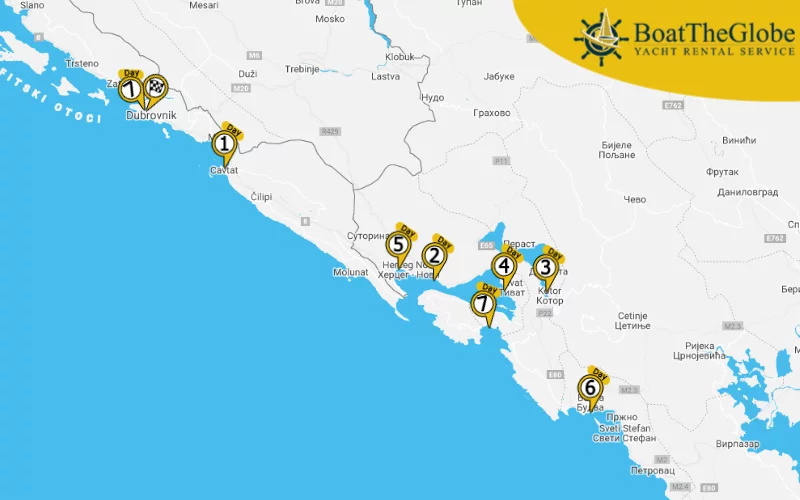
More Dalmatia sailing itineraries or Montenegro sailing tour
How to choose a sailing route from Dubrovnik to Montenegro?
- If you want a relaxed and scenic week: choose the one-way route with drop-off in Bar or another Montenegrin base.
- If you want more time under sail: choose the round-trip version, because it includes longer passages and more serious navigation decisions.
- If you sail in summer: expect busier marinas, a tighter daily rhythm and the need for advance berth planning.
- If you sail in spring or autumn: monitor the Bora and Jugo carefully, and keep a shorter backup plan ready.
Marine gas in route from Dubrovnik to Montenegro
- DUBROVNIK, ACI Marina: Depth: 4m, Working time: 8-20, GPS Coordinates: 42.670687, 18.127007
- DUBROVNIK, Orsan: Depth: 3, 7 – 4, 9 m, Working time: 6-22, GPS Coordinates: 42.660463, 18.079714
- KOTOR: Depth: 8, 5 m, Working time: 0-24 depending on the season (to be agreed upon before arrival) depending on the season (to be agreed upon before arrival), GPS Coordinates: 42.426348, 18.767266,
- TIVAT – Porto Montenegro: Depth: 12 m, Working time: 0-24 depending on the season (to be agreed upon before arrival) depending on the season (to be agreed upon before arrival), GPS Coordinates: 42.433897, 18.691430
- HERCEG NOVI – Portonovi Marina: Depth: 20 m, Working time: 0-24 depending on the season (to be agreed upon before arrival) depending on the season (to be agreed upon before arrival), GPS Coordinates: 42.433903, 18.603754
- BUDVA – Dukley Marina: Depth: 4 m, Working time: from May 1st through October 1st from 8-22, GPS Coordinates: 42.279906, 18.838321
- BAR – AD Marina: Depth: 5 m, Working time: 7-20, GPS Coordinates: 42.098617, 19.088010
Sailing the Dubrovnik Montenegro Route FAQ
When is the best time to sail from Dubrovnik to Montenegro?
Late June-August is the most stable summer period, while May-June and September-October are ideal if you want fewer crowds and more pleasant temperatures.
Should you border crossing administration by boat?
Yes. You need to check out of Croatia, check in in Montenegro, and then do it the other way around on the way back – do this in the designated ports.
Can this route be undertaken by beginners?
The one-way route can be undertaken by beginners to intermediate level with an experienced skipper or a more experienced team; the round trip version is more intermediate to advanced.
Why is the round trip more difficult?
Because the return trip is more often a longer, upwind journey, and you have to focus on timing the departure and port well at the end.
How much more expensive can a one-way charter be?
Many fleets charge a separate one-way fee for one-way drop-off (due to logistics), so the price depends on the offer – it is worth clarifying in advance.
What should I look out for in the Bay of Kotor?
The wind direction/strength can change quickly due to the topography, so expect sudden gusts and plan to have a port of refuge nearby.
Where is it worth spending time before/after?
The old town and city walls in Dubrovnik, the old town of Kotor in Montenegro and the spectacular points of the Boka Bay are the best “plus day” programs.
Choose the Dubrovnik–Montenegro route that matches your experience level and preferred charter style, then plan the border crossing, marinas and longer sea passages with precision. With the right itinerary, this passage becomes one of the most memorable sailing experiences on the Adriatic.
